Princeville’s Queen’s Bath: Beauty, Power, and Risk


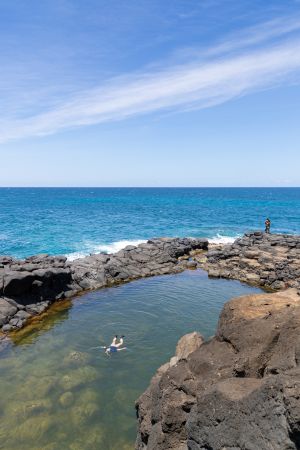
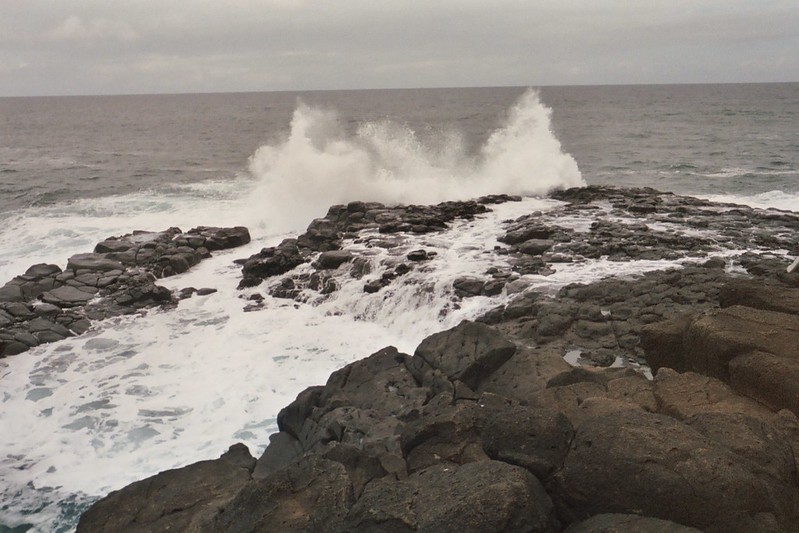
Queen’s Bath is one of the most dramatic places in Princeville and on Kaua‘i’s North Shore. Many people—residents and visitors alike—enjoy walking the trail to see the ocean, watch waves explode against the lava shelf, or take photos of the natural pool carved into the rock. The site is stunning. It is also dangerous. Understanding Queen’s Bath means knowing its history, location, seasonal limits, and a record of serious accidents.


A Short History

The name “Queen’s Bath” finds its origin with earlier Hawaiian bathing pools used by ali‘i, (persons of high rank) but the current was formed when lava flowed into the ocean and hardened into a natural basin. With Princeville’s development in the 1970s, the pool became a known landmark. Social media later turned it into an even bigger attraction.


Where It Is in Princeville

Queen’s Bath sits at the end of Punahele Street and Kapiolani Loop, Behind the gate, a steep trail leads down through mud and roots. The trail ends on a wide lava shelf above the ocean. You will need to walk a couple of hundred yards west on this shelf to the bath. This shelf is fully exposed to open ocean waves which may push you against rocks or take you out to sea. Unlike Hanalei Bay, there is no reef or lagoon in front of it to protect you.


Why Weather and Seasons Matter

The North Shore is famous for huge winter surf. Queen’s Bath becomes extremely dangerous from November through April, when waves slam over the rocks and fill the pool with violent water. The County posts warning signs each winter. Even in summer, a “calm” day can turn dangerous when a long-period swell arrives from far away.


Documented Accidents

Queen’s Bath has a long history of serious injuries and deaths. Accidents happen in two main places:

  • The Trail: Hikers often slip in mud, lose footing on roots and wet rocks, and injured visitors must sometimes be carried uphill by rescuers.
  • The Lava Shelf: Unexpected waves can sweep people off the rocks and pull them into deep, turbulent water, where escape becomes almost impossible. Many victims are slammed against the lava shelf by backwash and surf, and several drownings have occurred over the past decades.

These events often happen when people stand near the edge for photos—just seconds before a large set of waves arrives.


Why the Risk Is High

Four factors make Queen’s Bath one of Kaua‘i’s most hazardous spots:

  1. Unpredictable surf – Set waves can appear without warning.
  2. Low rock shelf – Waves easily wash over the entire area.
  3. Strong backwash – Water pulls victims outward after impact.
  4. Slippery surfaces – Algae and spray reduce balance and footing.

Practical Safety Notes

For both residents and visitors:

  • Do not go in winter.
  • Stay away from the edge, even on calm days.
  • Expect the trail to be muddy and slick.
  • Check surf forecasts, but remember they are not guaranteed.

In Closing

Queen’s Bath is part of what makes Princeville special—wild coastline, sweeping views, and the raw power of the Pacific. But it is also a place where many people have hurt themselves on the slippery trail, especially after heavy rain, or misjudged the ocean and paid a terrible price. Queen’s Bath will always be beautiful. It should also be approached with care.


Links

Kauai North Shore

Photos on Flickr

Wikimedia

Housing Values in Princeville, Kauai

This post reflects only the writer’s personal opinion and is not intended as legal or investment advice.

Key Data

  • In October 2025, the median sale price in Zip Code 96722 (Princeville, HI) was about US$1.10 million, down about 0.9 % year-over-year. (Redfin)
  • For the broader Princeville area, the average home value was around US$1.396 million as of late 2025, down 4.0 % over the prior year. (Zillow)
  • A data-source notes that between 2022 and 2023 the median property value in Princeville rose from about US$992,600 to about US$1.22 million (about +22.4 %). (Data USA)
  • In comparison, from 2022 to 2024 the average house value in the County of Kauai rose 16.7%
  • For October 2025, the county average home value is reported via Zillow at $998,463, down 2.8% over the prior year. Zillow. Also for October 2025, the average listing-price change (county) shows a year-over-year drop of 5.13%. (FRED). Another source reports for October 2025 the median sale price for single-family homes in Kauai was $1,595,000, up 33% compared to October 2024. (Locations Hawaii). This was likely because a few expensive properties sold in October 2025 versus October 2024.

What Does this Mean?

These numbers can always be debated, especially in a relatively small real estate market such as Kauai, but the trend for Princeville may be on a downtrend. This is taking place at a time when mortgage interest rates are dropping, when we would expect house values to go up (because affordability increases when mortgage rates drop.) One possible reason for the Princeville real estate market slide may be the impact of a recent lawsuit between the Mull/White defendant and Starwood Capital Group (See below.) We will update this post in the coming months to show how real estate statistics change.

What’s the Mull/White- Starwood Capital Group lawsuit?

The Mull/White (homeowners) lawsuit (Mull & White v. SOF-XI Kauai PV Golf, L.P. – 5CCV-21-0000063) challenges Starwood’s plan to develop parts of the Makai Princeville golf course after 2026. The homeowners argue that long-standing land-use rules and safety concerns, especially about disturbing old cattle burial sites, prevent Starwood from building housing there. On June 14, 2025, the court ruled that the golf-course Dedication does not end in 2026 (The final judgment in favor of the plaintiffs was signed on August 6, 2025 by Kathleen Watanabe) and instead remains in force because it is subject to the automatic five-year renewal provisions of the Princeville CC&Rs. The judge also found that Starwood may not redevelop the Woods Course for housing or other non-golf uses, and issued an injunction blocking any ground-disturbing activity without approved testing and oversight.

The ruling effectively protects the area and places strict limits on future development until the community votes otherwise. Starwood (SOF-XI Kauai PV Golf, L.P.) filed a Notice of Appeal on September 5, 2025 in the Hawai‘i Intermediate Court of Appeals (ICA) as CAAP-25-0000609. The appeal is likely to be fully briefed by mid-2026, with oral arguments (if granted) occurring in late 2026, and a written decision issued several months afterward, likely in 2027.

What are the Likely Impacts of the Mull/White suit on Princeville Property Values?

The Mull/White lawsuit against Starwood has likely direct and indirect effects on how people think about the future of housing in Princeville. The case deals with two major issues:

  • Whether the golf course land can be developed after 2026, and
  • Whether disturbing the land could release buried anthrax spores from events more than 100 years ago.

Market Confidence and Perceived Stability

Princeville buyers want a clear and predictable future, and a long legal fight between homeowners and a major landowner makes people unsure about what will happen next. When potential buyers read about lawsuits, land-use arguments, CC&Rs, or even possible health concerns, many hesitate or expect lower prices. This uncertainty grows the longer the dispute continues, and it affects how confident people feel about investing in the area. As a result, home prices may slow down or level off until the case is settled and the future of the land becomes easier to understand.

Impact on Future Development Rights

Princeville’s long-term housing value depends on the idea that it will remain a well-managed planned community with protected open spaces and limited new building. The Mull/White lawsuit challenges what development can happen after 2026. If Starwood wins, more construction could be allowed, increasing the number of homes. If the Mulls/White win the appeal, development may stay limited, likely keeping the Woods course undeveloped open.

Princeville was originally zoned as an “urban” area to support a planned community with homes, resorts, and shared amenities surrounded by attractive open areas. The open space idea was tied to views, recreation, and natural beauty accessible outside of Princeville to all. The Woods Course, however, is not especially scenic. It is heavily altered, and has limited recreational or environmental value. Because of this, some people argue that calling the Woods Course “open space” does not fit the original goals for Princeville, since it does not provide the type of meaningful open area that supports the community’s character. In this view, treating the Woods Course as protected open space may work against the planned community objectives by freezing land in a form that was never intended to serve long-term residents or enhance the experience of living in Princeville.

In Summary…

The ongoing appeal of the lawsuit creates uncertainty, which is one of the strongest short-term pressures on real estate values. Buyers tend to hesitate when they sense unresolved legal risk, and some may delay purchases or negotiate harder on price until the outcome is clear. This “wait-and-see” behavior can soften values temporarily, even if the long-term fundamentals remain strong. The issue is not the eventual ruling itself, but the uncertainty surrounding it.

At the same time, there is a broader question about whether the Woods Course should be treated as meaningful open space within Princeville’s original planned-community vision. The area is heavily altered and offers limited scenic or recreational value, so freezing it in place may not strengthen the community’s long-term appeal. Some argue that calling it “protected open space” goes against the original planning goals, which centered on high-quality views, recreation, and attractive shared environments. If residents and buyers view the land as underutilized, perceptions of stagnation could dampen value growth.

If the Woods Course were instead redeveloped with high-value homes, the effect on overall prices would likely be positive. New luxury construction raises the community’s price ceiling and establishes stronger value benchmarks. Once the land is built out, Princeville becomes more scarce—an important driver of long-term appreciation in resort markets.

The appeal creates short-term drag, but a clear end to litigation plus a strong, well-designed plan would likely strengthen confidence and support community-wide appreciation. Conversely, ongoing uncertainty or a poorly communicated vision could hold back the market for a while. Over the long term, certainty and high-quality use of the Woods Course land are the conditions most likely to raise values throughout Princeville.

***

Weekly & Monthly Markets on Kauai’s North Shore

Nothing feels better than driving a few miles out of Princeville to visit one of the many farmers and craft markets on Kauai’s North Shore. Fruits and vegetables are sure to be at their peak when you buy them. The selection changes every week as each season brings new discoveries,including: rambutan, longan, lychee, starfruit, cherimoya, soursop, mountain apple, lilikoi, dragon fruit, breadfruit, tangelos, poha berries, abiu, jaboticaba, taro varieties, okinawan sweet potato, turmeric root, galangal, winged beans, malabar spinach, chayote squash, bitter melon, moringa leaves and pods, upland taro, malaysian taro. Of course you can find other spectacular fares in season, including mangos of all varieties, avocados or different sorts, local bananas, local pineapples in season, varieties of lettuces, carrots, beans, cucumbers, squash, mint, basil, parsley, string beans, etc. etc.

Below is a schedule of the main markets around Princeville, subject to change.

Waipa Farmers Market

Location: Waipa Foundation, Hanalei
Day: Tuesday (weekly)
Type: Farmers, food, crafts, some art

Hanalei Farmers Market

Location: Hanalei (near Hale Halawai)
Day: Saturday (weekly)
Type: Farmers, crafts, art
Every Saturday from 9:30 a.m. to noon, a large grassy lawn off Malolo Road is covered with more than 50 stalls. 

Kilauea Farmers Market

Location: Kilauea Community Ag Center
Day: Thursday (weekly)
Type: Farmers, prepared foods, local products

Kīlauea Sunshine Market

Location: Kilauea Neighborhood Center
Day: Thursday morning (weekly)
Type: Farmers, flowers, plants

Anaina Hou Community Market

Location: Anaina Hou Community Park, Kilauea
Day: Saturday (weekly)
Type: Produce, fruit, Crafts, art, food vendors
Supports local agriculture, sustainable food distribution, local artisans, and the Kauai economy. With over 30 unique vendors, the market showcases the best of Kauai Grown Produce and authentic Kauai Made Crafts. Don’t forget Midnight Bear Bread

Kilauea Art Night

Location: Downtown Kilauea
Day: Last Saturday (monthly)
Type: Art, crafts, music, food

Princeville Makers Market

Location: Princeville Center
Day: Most Sundays
Type: Art, crafts, some food vendors

Makai Arts & Music Festival

Location: Princeville Makai Golf Course
Day: Wednesday (weekly)
Type: Art and crafts (local makers; some packaged food)

Princeville’s Founding and Governing Documents

From its early design in the 1970s to today’s neighborhoods, Princeville has been guided by a plan, and founding documents that have shaped how the community looks, grows, and works together. This post gives a short summary of those documents and what they mean for Princeville now. These documents are available to PHCA members via password-protected access to the association’s site.

Planned Community

Princeville is built based on a master design — streets, homes, parks, and open spaces arranged with a sense of order and purpose. In Princeville’s case, this means balancing homes, hotels, golf courses, trails, and green areas under one set of rules that everyone — homeowners, condominium associations, and local businesses — agrees to follow. It also means that owners contribute to the upkeep of shared spaces through dues managed by the Community Association (PHCA).

PHCA Charter of Incorporation (1971)

This document created the Princeville at Hanalei Community Association (PHCA) as a nonprofit organization. It gave PHCA the legal authority to manage community affairs, collect assessments, and represent all property owners.

PHCA Bylaws (1971)

The bylaws explain how the Association runs: how board members are elected, what powers the Board holds, and how meetings and voting take place. They make sure community decisions are made openly and fairly.

Protective Covenants (1971)

Also known as the CC&RsCovenants, Conditions, and Restrictions — this document defines how property can be used. It sets standards for home design, landscaping, and land use to maintain a consistent look and protect property values. Changing these covenants takes a 75% vote of all owners, showing how deeply they shape Princeville.

Community Rules (updated 2019)

Community rules are practical, everyday rules that apply the older covenants to daily life. They cover topics like noise, parking, pets, and use of common areas. The PHCA Board can update these rules by majority vote, allowing PHCA to respond to new community needs.

Community Design Committee (CDC) Rules (2021)

The Community Design Committee oversees how homes and landscaping look throughout Princeville. All exterior changes, from repainting to new construction, must be reviewed and approved by the CDC. These rules are designed to keep Princeville consistent with its natural surroundings.

Multi-Family Unit Guidelines (1990)

This document, and these rules apply to condominiums and timeshares. They set standards for shared buildings and grounds, ensuring that these complexes blend with single-family neighborhoods and the broader landscape.

Procurement and Bidding Policy (Policy 5, 2023)

This Board policy ensures that community money raised by PHCA is used wisely. All large purchases must be bid competitively and handled ethically. Local vendors get preference when possible, and conflicts of interest are prohibited. The policy is designed to reflects good stewardship of members’ dues.

Princeville Governance Overview (2019)

Written by former PHCA General Manager Rory Enright, this document explains how everything fits together, from the Board and the Community Design Committee to the PHCA staff. It reminds owners that participation is the heart of good governance and that a healthy community depends on active members, not just rules.

Hawaiʻi State Laws (Chapters 421J and 414D)

These state laws govern how all planned communities and nonprofit associations in Hawaiʻi must operate. They require transparency, annual meetings, financial reporting, and fair elections — ensuring homeowners’ rights are protected statewide.

Why It Matters Today

Princeville’s founding documents were written more than 50 years ago, yet they continue to shape how the community grows, looks, and interacts. Together, they form the backbone of local governance, setting the rules that keep Princeville beautiful, its infrastructure in good condition, and promote cooperation among residents, owners, and visitors.

***

Princeville Harmony & Community Aloha (PHCA)

Lately, too much energy in Princeville has been spent on disagreement rather than connection. Board meetings, neighborhood threads, and daily interactions sometimes feel divided—losing sight of what makes this place special. This post is a reminder to pause and return to the foundation that built Princeville: a shared sense of community rooted in respect, cooperation, and Aloha. Before policies or procedures, there was a vision—a neighborhood where people care for one another and for the land they share. “Princeville Harmony & Community Aloha” is not just a pretty phrase; it’s an invitation to rebuild trust and rediscover the harmony that defines our home.

 “Community” is more than shared property or rules—it reflects a collective commitment to living with respect, care, and mutual responsibility. The words Harmony & Community Aloha together speak to balancing individual rights with the greater good, recognizing that our individual homes and landscapes matter, and so does our shared life-space. Our Association founding documents articulate that membership entails obligations: to maintain common areas, to respect design guidelines, to participate in decision-making and to act in the neighborhood’s longer-term interest. The founding documents stress that residents join a community by virtue of ownership and accept that their individual interests are linked to the collective well-being.

A Planned Community…

Under the Hawaii Revised Statutes § 421J (Planned Community Associations Act) a “planned community” means property subject to a declaration that requires owners and an association that owns or maintains property for the common use or benefit of the owners. (Justia) – more on this in a forthcoming post. This framework defines community as including: shared use of common areas; non-severable membership; mandatory assessments; and governance through an association. (Justia)   In this setting, when you own a unit or lot, you automatically become a member of the association, you have rights (e.g., vote; attend meetings) and responsibilities (e.g., adhere to rules; pay assessments). (FindLaw Codes) The success of the community depends on participation, transparency, stewardship of shared assets, and a mindset that the community is not just a home—it’s a neighborhood “ecosystem”.

Community Aloha

  • Transparency in governance and decision-making;
  • Active participation—your voice matters;
  • Mutual respect for diverging views and shared spaces;
  • Stewardship of common assets, including landscaping, infrastructure and aesthetics;
  • Cultural awareness—honoring local values and environment.
What does “community” mean to you in Princeville? How do you envision PHCA fulfilling its purpose of Harmony & Community Aloha moving forward?
Please comment below!

Building Princeville: From Ranch Land to Resort Community

Princeville began in the mid-1800s as a large cattle ranch on Kauai’s North Shore. The land was first known as the Hanalei Plantation, where sugarcane and taro were grown. In 1860, it became a ranch owned by Scottish settler Robert Crichton Wyllie, who served as a cabinet minister to King Kamehameha IV. Wyllie named the area “Princeville” in honor of a royal visit by the young Crown Prince Albert (Prince Albert Edward Kauikeaouli Kaleiopapa a Kamehameha), son of the King and Queen Emma. The ranch covered thousands of acres overlooking Hanalei Bay and remained mostly agricultural for more than a century.

In the 1960s, the land that had been the Princeville Ranch was sold by the Wilcox family to a group of mainland investors and developers led by Eagle County Development Corporation (ECDC) of Colorado. Headed by businessman Doug Hoyt and engineer Donn “Curly” Carswell, ECDC purchased roughly 9,000 acres of the old ranch with a plan to create Kauai’s first large-scale resort and residential community. The developers hired the Honolulu planning firm Belt, Collins & Associates to prepare a comprehensive master plan. Their vision was to combine resort living, golf, and open space with the natural beauty of Kauai’s North Shore, setting aside large areas for parks, greenbelts, and a 27-hole golf course designed by Robert Trent Jones Jr.

Between 1968 and 1971, ECDC began the work of turning open ranchland into a planned community. Roads, water lines, power, and sewer systems were installed to support the initial phase, which covered about 995 acres above Hanalei Bay. The first major roads—Ka Haku Road, Lei O Papa Road, and Hanalei Plantation Road—were laid out to form the backbone of the new community. The Princeville Hotel site, the Makai Golf Course, and the Princeville Shopping Center area were among the first projects completed. The developers also worked with the County of Kauai to secure zoning approvals and with the State Land Use Commission to classify the area for urban use.

In 1971, ECDC recorded the Princeville at Hanalei Declaration of Restrictions, Covenants, and Conditions, commonly known as the CC&Rs. These rules governed how homes could be designed, landscaped, and maintained, ensuring that Princeville would retain a consistent and attractive appearance. Construction of the first homes began soon after in the early 1970s, mainly around the golf course and near the Hanalei Bay Resort area. The Princeville Hotel opened later in 1985, marking the full arrival of Princeville as a destination community. The combination of careful planning, phased infrastructure, and design rules made Princeville one of Hawaii’s first true master-planned resort-residential developments.

***

2 responses to “Building Princeville: From Ranch Land to Resort Community”

  1. Ray J. Avatar
    Ray J.

    This history is fascinating, but it highlights a significant problem. Princeville was Hawaii’s first planned community, and the early rules and covenants were fairly weak in my view. The Makai golf course is protected by an agreement that expires soon.

  2. […] its early design in the 1970s to today’s neighborhoods, Princeville has been guided by a plan, and founding […]